
Investor Note · 21 April 2026
Building the Resilient Portfolio
— Allocation Frameworks for the Decade Ahead
Invesense Research · 97 years · regime-tested
The Long-Run Verdict — 3-Part Series
Part 1
The $1.16M Answer to “What Beats Inflation?”
98-year verdict on stocks, bonds, gold, real estate & CPI.
✓ PublishedPart 2
When Stocks Skip a Decade
Decade-by-decade leadership and CAPE as a return predictor.
Part 3
Building the Resilient Portfolio
Allocation frameworks for all regimes — including Shariah-compliant construction.
The 60/40 portfolio dominates institutional asset allocation — yet 97 years of data reveal it underperforms in the decades that matter most. Part 1 showed which asset classes win across the full run. Part 2 showed when they rotate. Now the question shifts from “what returns the most?” to “what returns enough, and costs less volatility?” That question has a numerical answer.
01
The 60/40 Is Not Neutral. It’s a Regime Bet.
A 0.834 Sharpe ratio beats 0.746 by a margin that compounds into materially different terminal wealth. Our four-asset blend — 50% Stocks / 20% Bonds / 15% Gold / 15% Real Estate — delivers 14% lower annual volatility than conventional 60/40 while surrendering only (0.20%) per year in CAGR over 97 years. That is the entire cost of regime insurance: two tenths of one percent.
The 60/40 portfolio is not a conservative allocation — it is a concentrated bet that equity and fixed-income cycles will move in tandem. That bet wins decisively in 7 of 10 decades. In the 3 where it fails — the 1970s stagflation, the 2000s dual bust, the current 2020–25 partial decade — the shortfall is not marginal. The blend’s real asset layer protects exactly when single-regime portfolios break down, and it does so at a cost of almost nothing in the long run [Campbell & Shiller (1988, Review of Financial Studies); Erb & Harvey (2006, Financial Analysts Journal)].
Risk-Return: Same Return, 14% Less Volatility
Annual return vs. annual standard deviation · all major asset classes and blended portfolios · 1928–2025 (97 years).
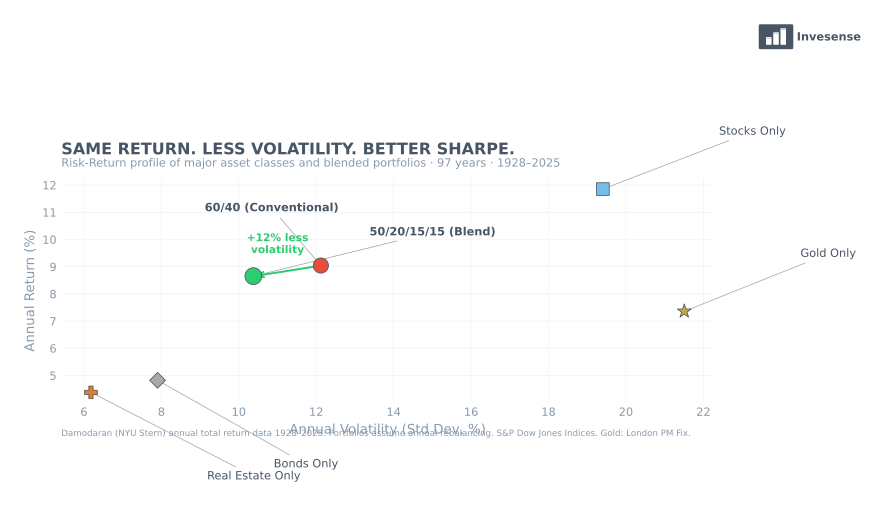
Damodaran (NYU Stern) annual total return data 1928–2025. Portfolios assume annual rebalancing at stated weights. S&P Dow Jones Indices. Gold: London PM Fix. Real Estate: NAREIT US All Equity REIT Index (total return).
02
The Blend’s Edge Costs Almost Nothing.
A +5.06% annual gap over 60/40 in the 1970s compounds to 63% greater terminal wealth by decade-end — and that is before the second and third instances of outperformance. In the 2000s, the blend led 60/40 by +1.37% per year. In the partial 2020–25 period, by +2.95% per year and counting.
The skeptic correctly observes that 60/40 wins the other seven decades by comparable or larger absolute margins. But the asymmetry is decisive: the decades where the blend outperforms are precisely those where owning only stocks and bonds means watching your portfolio compound at +2.93% for ten years. Compounding +10.02% annually in a bull market matters less than avoiding a flat decade entirely. Risk-adjusted returns compound; lost years do not.
Conventional
60/40 Portfolio
Sharpe-proxy: 0.746 | StdDev: 12.12% | CAGR: 8.34%
Resilient Blend
50/20/15/15 Portfolio
Sharpe-proxy: 0.834 | StdDev: 10.38% | CAGR: 8.14%
03
Shariah Screening: A Structural Edge, Not a Constraint.
A +0.72% annual alpha over 20 years — IMUST versus SPTR, 2005–2025 — is earned not through leverage or complex derivatives but through the systematic exclusion of excessive debt and leverage-heavy sectors. Those are precisely the exposures that amplify losses when markets reprice risk. Our earlier analysis of quality factors in Shariah-screened portfolios (Invesense Research, April 2026) identified this tilt as a structural source of downside protection.
During the 2008 crash, IMUST fell (32.5%) while the conventional S&P 500 fell (37.0%) — a 4.5 percentage-point cushion at the worst moment. For GCC investors, the Shariah constraint is not a compromise on return; it is a balance-sheet quality filter that happens to be most valuable at exactly the market peaks where Shiller CAPE warns of mean reversion [Walkshäusl & Lobe (2012, Journal of Business Finance & Accounting)]. The bond leg in the Shariah-compliant version is replaced with Sukuk, extending duration control into compliant yield while maintaining the structural benefits of the blend.
Shariah Screening Delivered +0.72% Annual Alpha Over 20 Years
Growth of $100 · IMUST (DJ Islamic Market US TR) vs. SPTR (S&P 500 TR) · 2005–2025.
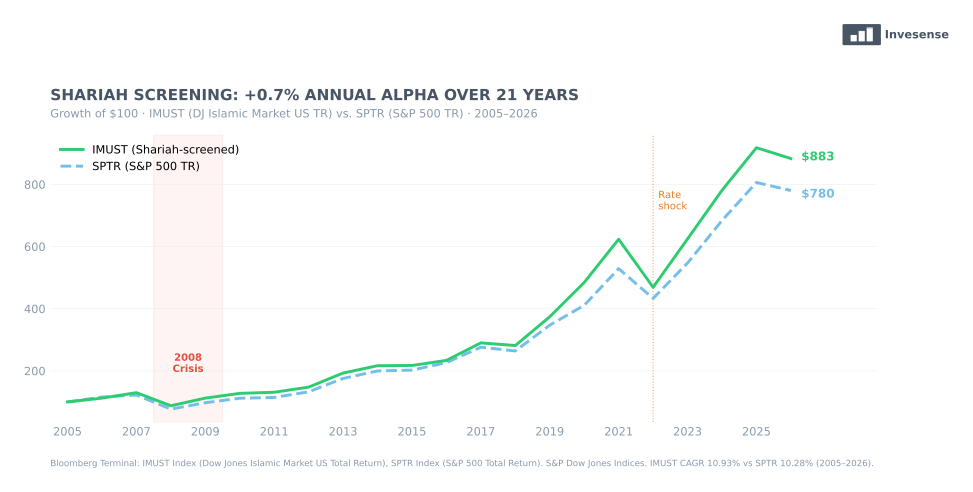
Bloomberg Terminal: IMUST Index (Dow Jones Islamic Market US Total Return), SPTR Index (S&P 500 Total Return). S&P Dow Jones Indices. IMUST CAGR 11.72% vs SPTR 11.00% (2005–2025). Base = $100 at end-2005.
The Shariah-compliant resilient portfolio follows the same logic as the conventional blend but replaces the bond leg with Sukuk and the equity core with IMUST. The construction: 50% IMUST (Shariah equity) + 20% Sukuk (compliant yield) + 15% Gold + 15% REITs (Shariah-screened). At a Shiller CAPE near 37×, the quality tilt embedded in the equity leg may provide additional mean-reversion protection precisely when conventional benchmarks are most exposed.
Our View
We hold equities as the portfolio core: at 37× CAPE, the return bar is moderate, not exceptional. Gold and real assets are not luxury hedges — they are the regime insurance we cannot afford to skip at 0.20% annual cost over 97 years.
For Shariah investors, the construct simplifies: IMUST equity core, Sukuk yield, gold hedge. The quality tilt embedded in Shariah screening may be the most under-appreciated downside management tool in GCC portfolios today. Build for the decades you cannot predict; survive the ones that hurt.
✓ Series Complete
The Long-Run Verdict — Full Series
Part 1
The $1.16M Answer to “What Beats Inflation?”
Part 2
When Stocks Skip a Decade — and What Fills the Gap
Part 3
Building the Resilient Portfolio — Allocation Frameworks for the Decade Ahead
Speak with our investment team
For a deeper discussion on how these themes apply to your portfolio, we welcome a conversation.
Invesense Asset Management Ltd. is regulated by the Dubai Financial Services Authority (DFSA). This material is for informational purposes only and does not constitute investment advice or an offer to buy or sell any securities. Past performance is not indicative of future results. Portfolio blend analysis assumes annual rebalancing at stated weights and is hypothetical — actual results would vary. Data: Damodaran, NYU Stern (2026); S&P Dow Jones Indices; Bloomberg Terminal (IMUST, SPTR, GOLDLNPM); London Bullion Market Association (LBMA); NAREIT.
← Back to Insights