
Investor Note · 23 April 2026
What the Instruments Say —
and Why They’ve Been Wrong
CAPE explains 44.7% of decade-forward return variance. At 37×, the regression says 1–2% forward. But CAPE has missed by 3.5–8.1pp every year since 2010. The map is real. The terrain changed.
Invesense Research · 88 observations · 1928–2025
37×
US Shiller CAPE
End-2025
+3.5–8.1pp
CAPE forecast miss
every year 2010–2015
4.5% → 11.7%
S&P 500 net margin
1991 → 2025
90%
Intangible assets as %
of S&P 500 value (2020)
The Valuation Compass — 2-Part Series
Part 1
What the Instruments Say — and Why They’ve Been Wrong
CAPE, margins, and the structural case for a transformed US equity market.
Part 2
Why This Time Is (Partially) Different
Mag 7 margins, the quality premium, and how to position portfolios when the terrain has changed.
Most investors treat valuation ratios as binary triggers — buy when cheap, sell when expensive. The academic evidence supports a more nuanced reading: CAPE is a legitimate decade-horizon tool, but it has systematically overstated US equity risk for 25 years. The reason is structural. The US economy shifted to a tech-driven, intangible-heavy, higher-margin composition. The regression was trained on a different economy. The map is real. But the terrain changed.
01
The Academic Case for Valuation Ratios.
Shiller’s CAPE ratio rests on solid empirical ground. Across 88 observations from 1928 to 2025, the relationship between CAPE and subsequent 10-year returns holds at R²=0.447 — meaningful by macro standards. The spread is material: companies trading in the first quintile (7.4–11.2×) delivered 15.5% annualized returns over the following decade, while those in the fifth quintile (22.9–44.2×) returned 6.2% — a 9.3 percentage point gap that compounds to the difference between doubling your capital and 80% growth. At end-2025, the S&P 500 CAPE stands at 37×, a level the regression associates with 1–2% forward returns (Campbell & Shiller 1988). Price-to-sales tells a starker story: IT at 9.94× now exceeds the 1999 peak of 6.28×. Meanwhile, EAFE trades at 17.3× — a 53% discount to US valuations.
02
The Persistent Forecast Misses.
Yet the instruments have systematically misfired on forward returns for a quarter-century. CAPE predicted 8.6% for the decade starting 2010; the actual return was 13.8% — a 5.1 percentage point miss. In 2014, the model called for 6.2%; reality delivered 13.0%. The pattern held through 2015, with every year from 2010–2015 seeing CAPE underestimate returns by 3.5–8.1 percentage points. Siegel’s critique illuminates part of the problem: GAAP revisions in the 1990s forced accounting write-downs that depressed reported earnings even as true economic earnings remained robust (Siegel 2005). More fundamentally, CAPE captures reported earnings — a metric that systematically undercounts the true profitability of technology companies that expense R&D. Intangibles have shifted from 17% of S&P 500 value in 1975 to 90% in 2020 (Ocean Tomo). The instruments measure the wrong denominator.
03
Index Recomposition, Not Organic Miracle.
The story is not that US companies became mysteriously more profitable. The story is that the index itself transformed. Net profit margins for the S&P 500 were 4.5% in 1991; by 2025 they had nearly tripled to 11.7%. The 1990s averaged 5.6%; the 2020s average 10.7%. This recomposition tracks the index’s migration toward asset-light, higher-margin businesses: tech and communications services grew from ~15% of the S&P 500 in 2000 to over 40% today. A ratio calibrated on the industrial-age economy — when the index was heavy in manufacturing, utilities, and capital-intensive sectors — cannot fairly value an economy where intangible assets now represent roughly 100% of tangible book versus 30% in 1963 (Research Affiliates). The “expensiveness” partly reflects that the US market now houses structurally superior businesses. The map was redrawn; the compass was not.
S&P 500 Net Profit Margin — The Structural Shift
1991–2025 · From 4.5% to 11.7% · The index recomposed itself
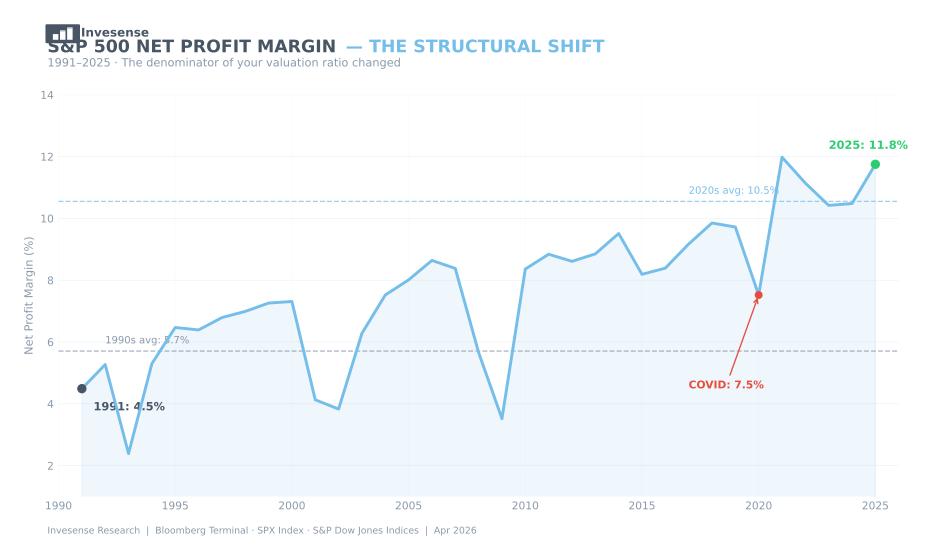
Bloomberg Terminal: SPX Index · S&P Dow Jones Indices.
Our View
Valuation ratios deserve respect as calibration tools, not dismissal as relic indicators. CAPE at 37× warrants caution. But the 1–2% forecast assumes a 50-year-old economic structure. The US equity market of 2025 is fundamentally different from 1975: margins have nearly tripled, intangibles dominate asset bases, the index composition has shifted decisively toward quality.
We do not reject the instruments. We contextualize them within a transformed economy. Part 2 examines what changed — and how it reshapes portfolio positioning.
Speak with our investment team
For a deeper discussion on how these themes apply to your portfolio, we welcome a conversation.
Invesense Asset Management Ltd. is regulated by the Dubai Financial Services Authority (DFSA). This material is for informational purposes only and does not constitute investment advice or an offer to buy or sell any securities. Past performance is not indicative of future results. Data: Damodaran (NYU Stern) 2025; Robert J. Shiller, Yale University; Bloomberg Terminal (SPX Index, SP5NINFT, NDDUEAFE); S&P Dow Jones Indices; MSCI; Ocean Tomo LLC. Shiller CAPE: annual December snapshots. Returns are total return indices.
← Back to Insights