
Investor Note · 28 April 2026
Why This Time Is
(Partially) Different
Mag 7 net margins at 32% vs dot-com’s 15%. Gross margins above 60%. $200B in annual FCF funding $650B in capex. The quality premium is real. The question is how to size it.
Invesense Research · Bloomberg · Company Filings
32.1%
Mag 7 avg net margin
2025 (vs 15.3% dot-com)
63.9%
Mag 7 avg gross margin
2025
21×
NVDA forward P/E
with 48% revenue growth
(53%)
EAFE discount to US
Our satellite overweight
The Valuation Compass — 2-Part Series
Part 1
What the Instruments Say — and Why They’ve Been Wrong
CAPE, margins, and the structural case for a transformed US equity market.
Part 2
Why This Time Is (Partially) Different
Mag 7 margins, the quality premium, and how to position portfolios when the terrain has changed.
In Part 1, we established that CAPE and P/S are legitimate tools that have been systematically wrong on US equities for 25 years — because the US economy structurally shifted. This raises the obvious question: if the terrain changed, what does it look like now? The answer is in the margins, the cash flows, and the quality factor. Today’s market leaders are not 1999’s market leaders. The numbers are not even close.
01
Dot-Com Delusion vs. Today’s Durable Profits.
The 1999 Nasdaq leaders — Cisco, Intel, Oracle, Qualcomm — averaged 15.3% net margins and 56.7% gross margins while trading at 100×–220× earnings on decelerating revenue. Today’s Magnificent Seven average 32.1% net margins and 63.9% gross margins. Nvidia trades at 21× earnings with 48% projected revenue growth and 75% gross margins; Cisco 2000 traded at 220× with negative momentum. The S&P IT sector trades 58% above 1999 on a price-to-sales basis, but margins are 2–3× higher — a fundamentally different equation. Hyperscalers deployed $650 billion in capex during 2026, funded by $200 billion in annual free cash flow, not leveraged debt (Citi). This is margin, growth, and self-funding capital deployed at scale.
02
US Structural Advantages Are Real, Not Cyclical.
The quality factor premium persists across 23 of 24 countries (Asness, Frazzini, Pedersen 2019). The Fama-French profitability factor (RMW) is statistically significant and economically durable. The US became a net energy exporter in 2019 — eliminating the macro vulnerability that shaped prior decades — while dollar hegemony continues to drive structural capital flows into US assets. Common-law investor protections command persistent valuation premiums (La Porta et al. 1998), and this advantage compounds over time. The US outperformed EAFE by approximately 4% annually over three decades despite EAFE trading at a persistent discount. These are not cyclical advantages. They are architectural.
Mag 7 Gross Margins — A Decade of Structural Profitability
2011–2025 · Bloomberg Annual Data
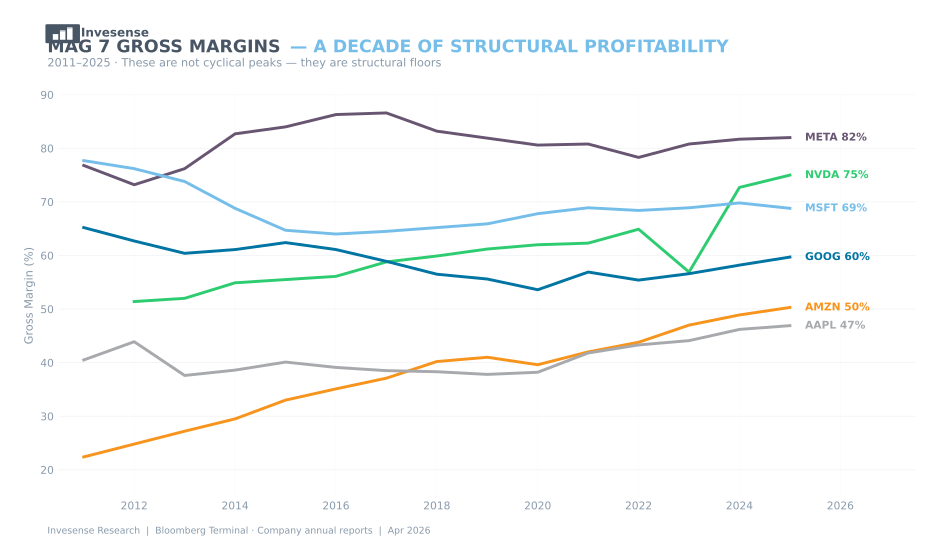
Bloomberg Terminal · Company annual reports.
03
Ratios Size Positions; They Don’t Time Markets.
Asness, Ilmanen, and Maloney (2016) argue that modest tactical tilts based on valuation spreads are justified — but only when spreads are unprecedented. Value can underperform for a decade before it works; the pain threshold is real. EAFE trades at a 53% discount to the S&P 500, warranting a modest satellite overweight of 5–10%, not a wholesale rotation. IT trades at 9.94× price-to-sales, which warrants position-sizing discipline and awareness, not panic selling. We use valuation ratios to calibrate exposure, not to capitulate to mean-reversion narratives that may not materialize within our investment horizon.
The Missing Context: P/S Is Higher, But So Are Margins
S&P IT P/S vs S&P 500 Net Profit Margin · 1990–2025
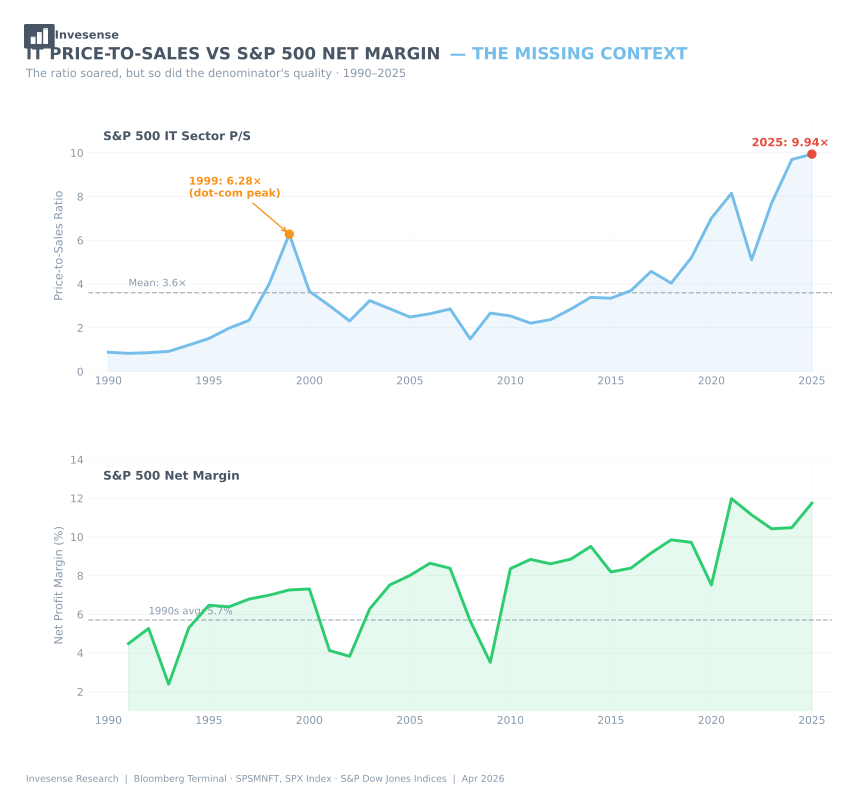
Bloomberg Terminal: SP5NINFT, SPX Index · S&P Dow Jones Indices.
What Could Go Wrong — We Acknowledge The Risks
Japan 1989 faced structural headwinds plus extreme valuation and suffered lost decades. The Magnificent Seven represent 33% of the S&P 500 — the highest concentration since the 1960s. Regulatory and antitrust risk are real. “This time is different” is investing’s most dangerous phrase. We acknowledge these risks and size accordingly.
Our View
We are US-focused because the fundamentals justify it. Companies earning 50–75% gross margins, double-digit net margins, and 20–30% segment revenue growth deserve premium multiples. We do not abandon valuation discipline — we contextualize it for the economy that exists. EAFE’s 53% discount earns a modest overweight in our allocation.
Ratios calibrate positions; they don’t time markets. The compass still works. You must recalibrate it for the terrain you’re walking.
✓ Series Complete
The Valuation Compass — 2-Part Series
Part 1
What the Instruments Say — and Why They’ve Been Wrong
Part 2
Why This Time Is (Partially) Different
Speak with our investment team
For a deeper discussion on how these themes apply to your portfolio, we welcome a conversation.
Invesense Asset Management Ltd. is regulated by the Dubai Financial Services Authority (DFSA). This material is for informational purposes only and does not constitute investment advice or an offer to buy or sell any securities. Past performance is not indicative of future results. Data: Bloomberg Terminal (company filings: AAPL, MSFT, GOOG, AMZN, NVDA, META, CSCO, INTC, ORCL, QCOM; SPX Index; SP5NINFT; NDDUEAFE); S&P Dow Jones Indices; MSCI; Damodaran (NYU Stern); and academic research cited inline.
← Back to Insights